
Summary
Herman Warner Muntinghe (1773–1827), the central figure of this study, was the primary architect of the new colonial state that took shape in the Indonesian archipelago in the early nineteenth century. Muntinghe was the only administrator to survive all regime changes in both the Indies and the motherland between 1806 and 1827, and the only one to retain his influence almost until the very end.
The book explores how Enlightenment ideas shaped the Dutch colonial state in the Indonesian archipelago and how Muntinghe, between 1806 and 1827, collaborated with his superiors to develop and implement these ideas. The key to this evolution in colonial governance lay not in The Hague or Batavia but in the interplay between contemporary political theory and practice in the Indies and the broader European colonial world. Many concrete plans did not originate from the drawing boards in The Hague but from on-the-ground experience in the archipelago. Special attention is therefore given to the opposing forces in the Indies, as the population’s response to colonial policy largely determined the government’s room to maneuver in Batavia.
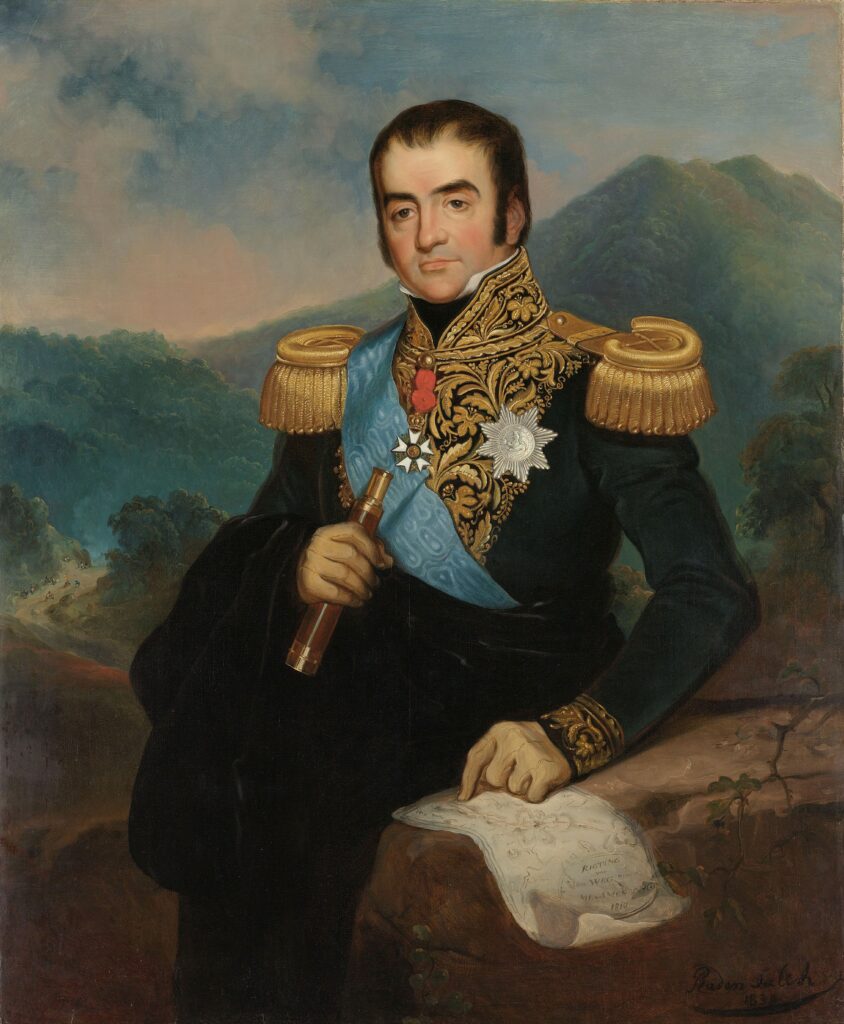
It was not only the disrupted communication during the wars with England that altered the relationship between the East Indies and the motherland. More significantly, it was the application of new ideas about the colonial relationship—ideas often interpreted entirely differently in the archipelago than in Europe. Thus, not only Daendels but also his successors, Raffles and Van der Capellen, developed strained relationships with the supreme government in Europe, and all three were ultimately replaced.
The worlds of the European motherland and the distant colonies clashed repeatedly. In London and The Hague, officials were astonished by the stubbornness of colonial administrators, while in Batavia, there was sometimes shock at the fundamental lack of understanding of the situation in the East Indies. In British India, where the transition from trade to governance over increasingly vast territories had begun shortly after 1750, and in the Dutch East Indies, new ambitions brought the emerging colonial state into conflict with indigenous states. Enlightenment ideas about natural law, human rights, and the slogans of the French Revolution created a strange paradox in the colonies. Alongside new ideas about the relationship with non-Europeans—such as those concerning slavery and forced labor—the colonizers’ ability to unilaterally impose their will on non-European populations had grown considerably, and the desire to generate substantial revenue was stronger than ever. It is the tension between these conflicting principles that repeatedly surfaces in the career of Herman Warner Muntinghe and his contemporaries in the East—a struggle temporarily resolved in 1830 with the introduction of the Cultivation System.
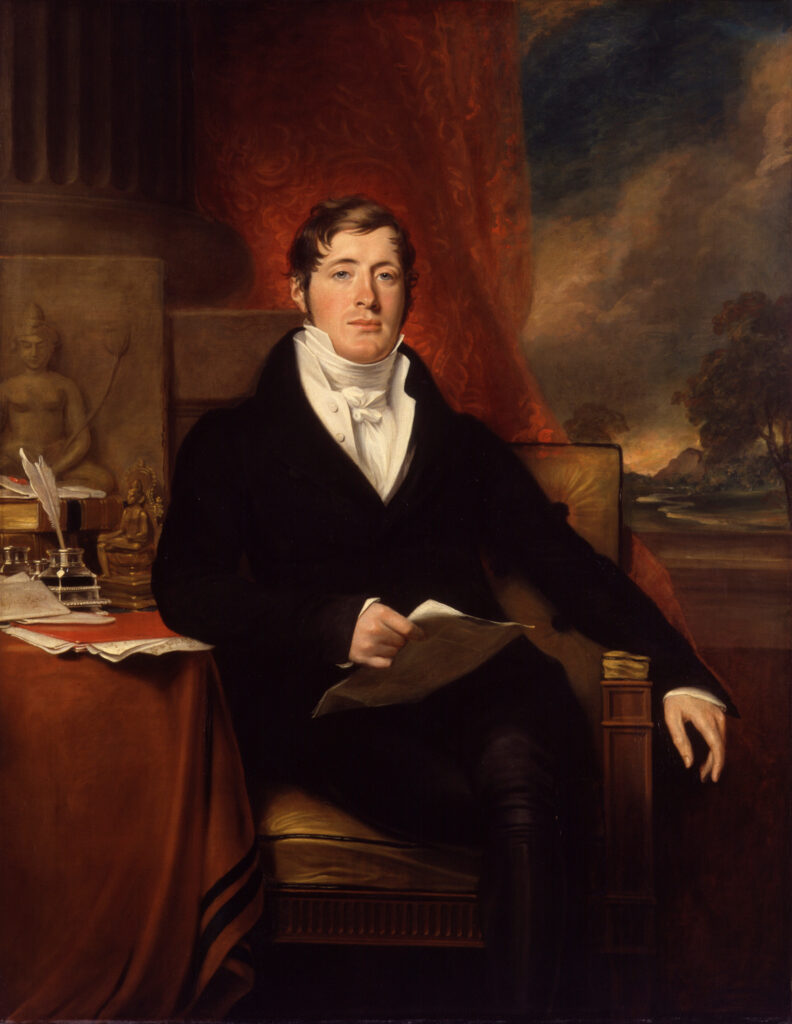
Sir Thomas Stamford Raffles, luitenant-gouverneur van Java 1811-1816, door Charles Hodges. National Portrait Gallery, Londen.
The major break with the VOC past in the Indies occurred between 1808 and 1816, the years in which the Napoleonic general Herman Willem Daendels and the British lieutenant governor Thomas Stamford Raffles demonstrated an immense drive for reform and implemented sweeping changes in the colony. These years coincide with Herman Warner Muntinghe’s rapid rise as chief adviser to the colonial regime, serving as secretary-general, president of the Supreme Court of Justice, and the most important member of Raffles’ council. The political power of Banten and Cirebon came to an end, while Yogyakarta and Palembang were effectively reduced to colonial protectorates. Competing centers of power were no longer tolerated. This rapid transformation left a deep impression on all involved. The consequences were not only political and military but also economic. Ultimately, the policies initiated by Daendels toward the most important autonomous states also had far-reaching implications for regions outside Java. Muntinghe played a significant role in this expansion.
Ideological disputes in the Indies primarily revolved around the concepts of free labor, the well-being of the population as a government objective, and the role of the indigenous nobility in domestic governance and justice. The new wave of ideas eventually collided with the desire to integrate the colonial population into the imperialist world economy at the lowest possible cost. This was particularly true of Muntinghe’s belief that the well-being of the Indonesian people should be a major goal of colonial policy—a perspective I describe in this book as humanitarian colonialism. To the modern reader, this concept is an inherent contradiction, as colonialism, with its unequal power dynamic between colonizer and colonized, is by definition not humanitarian. In the early nineteenth century, however, this was far from self-evident. On the contrary, a policy aimed at making the colony profitable without harming the population’s well-being was the core of colonial policy under Raffles and Van der Capellen, and the constant tension between these two objectives dominated Muntinghe’s life in the Indies. Humanitarian colonialism was therefore not an anti-colonial ideology but was tied to the economic and geopolitical ambitions of the government in Batavia.
The early nineteenth-century debate on the future of the former VOC possessions in the Indonesian archipelago was inherently transnational. Since the 1770s, Batavia had closely observed the rapid changes in British India and the new forms of exploitation being tested there. The British example was frequently cited in the publications of Dirk and Gijsbert Karel van Hogendorp and later in Muntinghe’s writings. The major issues concerning the British East India Company were subjects of debate in the British Parliament and were well covered in newspapers. The colonial discourse thus had a far more public character in England than in the Netherlands. In England, it culminated in the impeachment case against Governor-General Warren Hastings, led by the philosopher and politician Edmund Burke.
In this study, I use Muntinghe’s biography as a lens to better understand the origins of the colonial state. By connecting his personal history with the political and economic history of the colony, and by using Muntinghe’s long career as a starting point, both the coherence and differences between successive regimes become clearer. It reveals that the countless administrative experiments were preceded by lengthy discussions and that personal experiences could significantly influence the formation of new insights. Muntinghe’s life story also exposes the personal and political confrontation between the ideas and new norms of the (moderate) Enlightenment, the economic demands of the motherland, and the realities in Indonesia. The collision of these three elements created serious, inherently unsolvable problems for colonial administrators—problems that could ultimately crush even the most prominent figures, such as Muntinghe.
This biographical approach does not diminish the importance of the colonial administration’s institutional memory. However, this study also argues for another critical source of knowledge: the personal knowledge and experiences that colonial administrators brought with them from their own networks and families. Without insight into Muntinghe’s family history and his remarkable doctoral thesis, his humanitarian ideas would be incomprehensible. Without his experiences as a private landowner in Indramayu, the dramatic shift in his vision in 1817 would remain a mystery. Colonial officials and administrators were more than mere cogs in an imperialist machine; each brought their own preoccupations and histories.
What remains of Muntinghe’s legacy after two hundred years? The most visible remnants are the current borders between Indonesia, Malaysia, and Singapore. Had Muntinghe not expelled the British from Palembang in 1819, Raffles would not have founded Singapore that same year, and the boundaries between the British and Dutch spheres of influence would have been drawn differently in 1824. Secondly, the village (desa) continues to play a prominent role as an administrative unit in Indonesia—a role that emerged in the second decade of the nineteenth century under Muntinghe’s influence. Thirdly, there is the integrated approach to the archipelago’s economy. As Muntinghe envisioned, the economies of Sumatra, Borneo, and the other islands needed to be better connected to Java’s to strengthen the overall economy. Finally, there is the peculiar blend of humanitarian and economic goals in colonial (and international) politics. Muntinghe was not the only source of this blend, but he was one of its earliest and most influential advocates. The fundamental incompatibility of these goals defined Muntinghe’s life and work and posed new questions and challenges for every generation that followed.
The book is structured into eight chronological chapters covering both Muntinghe’s private life and his professional work. The extensive bibliography includes archival sources and literature.
Chapter I, The Education of a Colonial, covers Muntinghe’s life up to his departure for the Dutch East Indies in 1806, including his upbringing in a transnational environment, his parents’ serious marital problems, his student days, a long stay in England, and his early career at the Asian Council.
Chapter II, Daendels’ Machine, describes the state of the Dutch East Indies at the time of Muntinghe’s arrival in Java, his relationship with Governor-General Daendels, and his influence on the radical changes Daendels implemented. Here, we see the beginning of Muntinghe’s role as an intellectual pillar of the colonial regime.
This role was further strengthened under British lieutenant governor Raffles, the subject of Chapter III, Java as a Laboratory. In this chapter, we can trace the development of Muntinghe’s own ideas in detail for the first time. The major themes of this period were the sale of land to private individuals and the debate on free Javanese labor. Muntinghe played a leading role in both issues.
Chapter IV, A New Start, covers the arrival of the Dutch under the leadership of the triumvirate Van der Capellen, Elout, and Buyskes. After the Napoleonic and British years, the restoration government under Willem I finally had the opportunity to shape the colony’s development. With his extensive 1817 memorandum, Muntinghe set the course for the coming years. This chapter also explores how Muntinghe was deeply influenced by events on his own estates at the end of 1816.
In Chapter V, Muntinghe’s War, we encounter Muntinghe as an assertive and self-assured colonial administrator in Sumatra, where the commissioners-general had appointed him as commissioner in Palembang with extensive powers. He expelled the English under Raffles but suffered a significant defeat against Sultan Mahmud Badaruddin II. This chapter covers not only Muntinghe’s military expeditions into the interior but also their geopolitical consequences and religious context.
After Palembang and the departure of Elout and Buyskes, Muntinghe became the most important advisor to Governor-General Van der Capellen as a Councillor of the Indies (Chapter VI). He developed his ideas on a wide range of colonial economic and political issues and played a key role in the notorious case of private landowner Andries de Wilde, in which he became a strong opponent of European land ownership.
Chapter VII, Muntinghe’s Stay in the Netherlands and the NHM, first addresses the colonial treaty with England and then focuses on the establishment of the Dutch Trading Company—an original idea of Muntinghe’s that ultimately led to personal disappointment and his return to Java.
In the final chapter, Chapter VIII, Muntinghe’s Last Years, we see his personal and political decline: his influence waned, and his health deteriorated rapidly. A peace initiative to end the Java War failed, and in March 1827, he resigned as a Councillor of the Indies. The Epilogue examines Muntinghe’s “rediscovery” around 1850, when he became a source of inspiration for the growing number of critics of the Cultivation System. The book concludes with an overview of Muntinghe’s legacy.